Insurance
ClaimDesk
Storm-event claims intake and triage for 100 claims, where every decision cites the wording and uncertainty goes to a person.
In the demo you triage 100 storm claims for a fictional NZ insurer: approve the 84 fast-track claims in one reviewed action, correct a conflicting loss date that changes the policy version and reserve, and decide the remaining cases until nothing needs a decision now. Underneath: effective-dated policy resolution, limits and excess applied in wording order, an append-only reserve ledger and atomic reassessment.
- My role
- Sole engineer: spec to deployment
- Walkthrough
- 90-second guided scenario
- Focus
- Explainable, auditable claims decisions
Launch guided demo (opens in a new tab)Engineering evidence
Stack: React · TypeScript · PHP/Symfony · PostgreSQL · Playwright + axe
Independently built portfolio showcase · simulated data
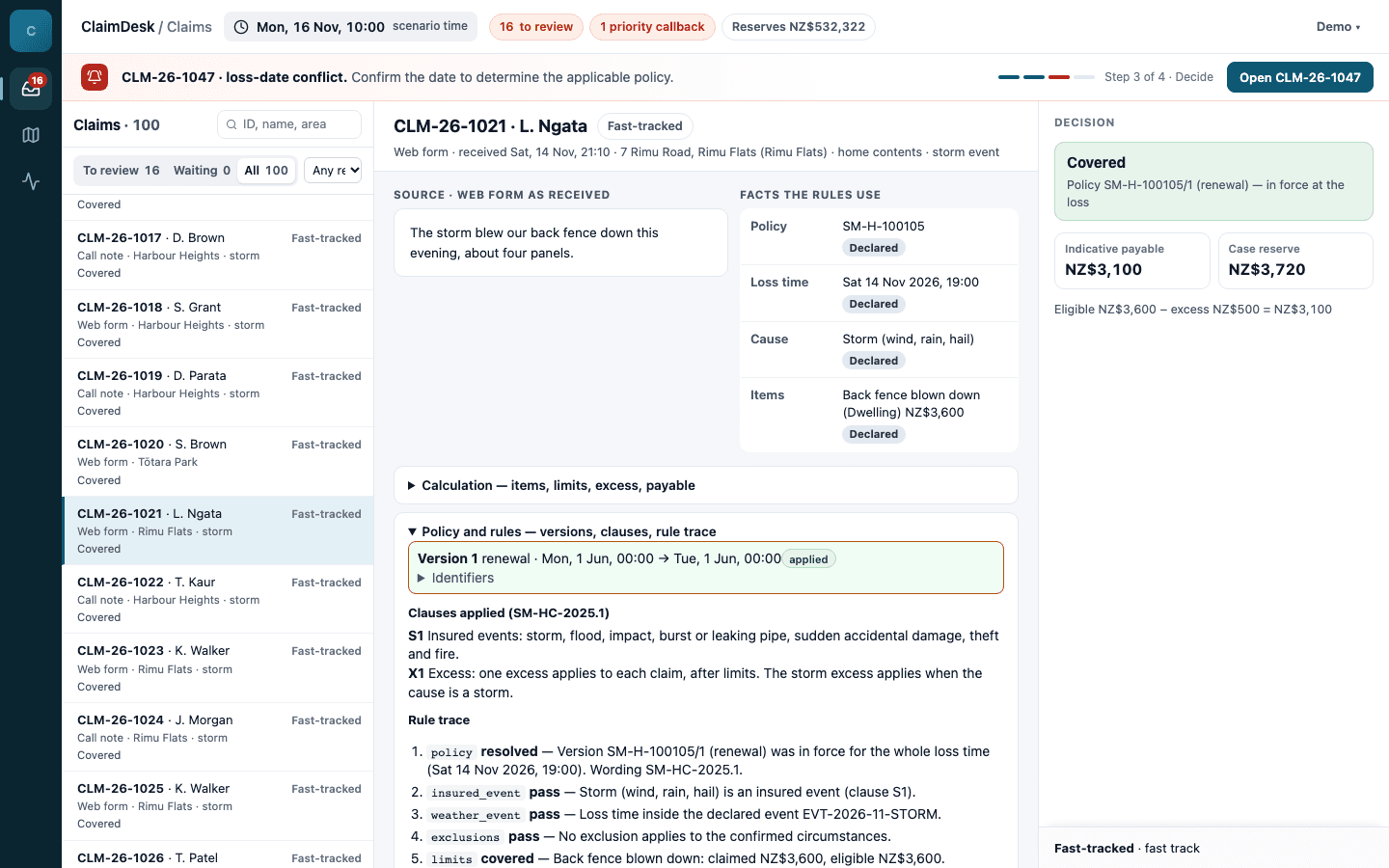
The business problem
After a storm, a claims team receives a wave of first notices of loss through web forms, call-centre notes and emails. Most are simple; some fall on a policy change, an exclusion, a limit, a support need or a possible duplicate — and those decide whether the customer gets a fast, fair, explainable answer.
Try the workflow
Step 1
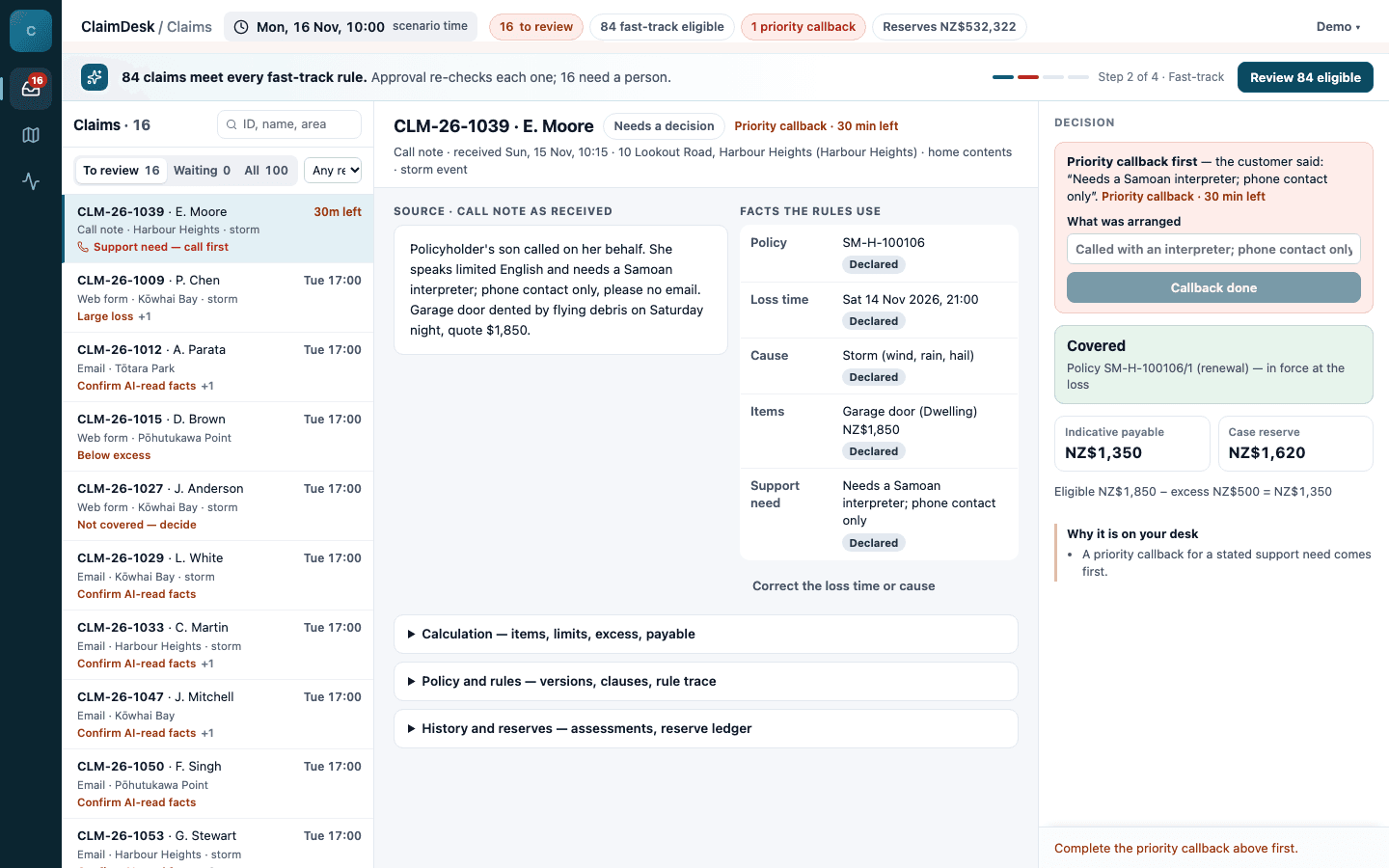
Intake: 100 storm claims assessed; 84 meet every fast-track rule, 16 go to a person. Step 2
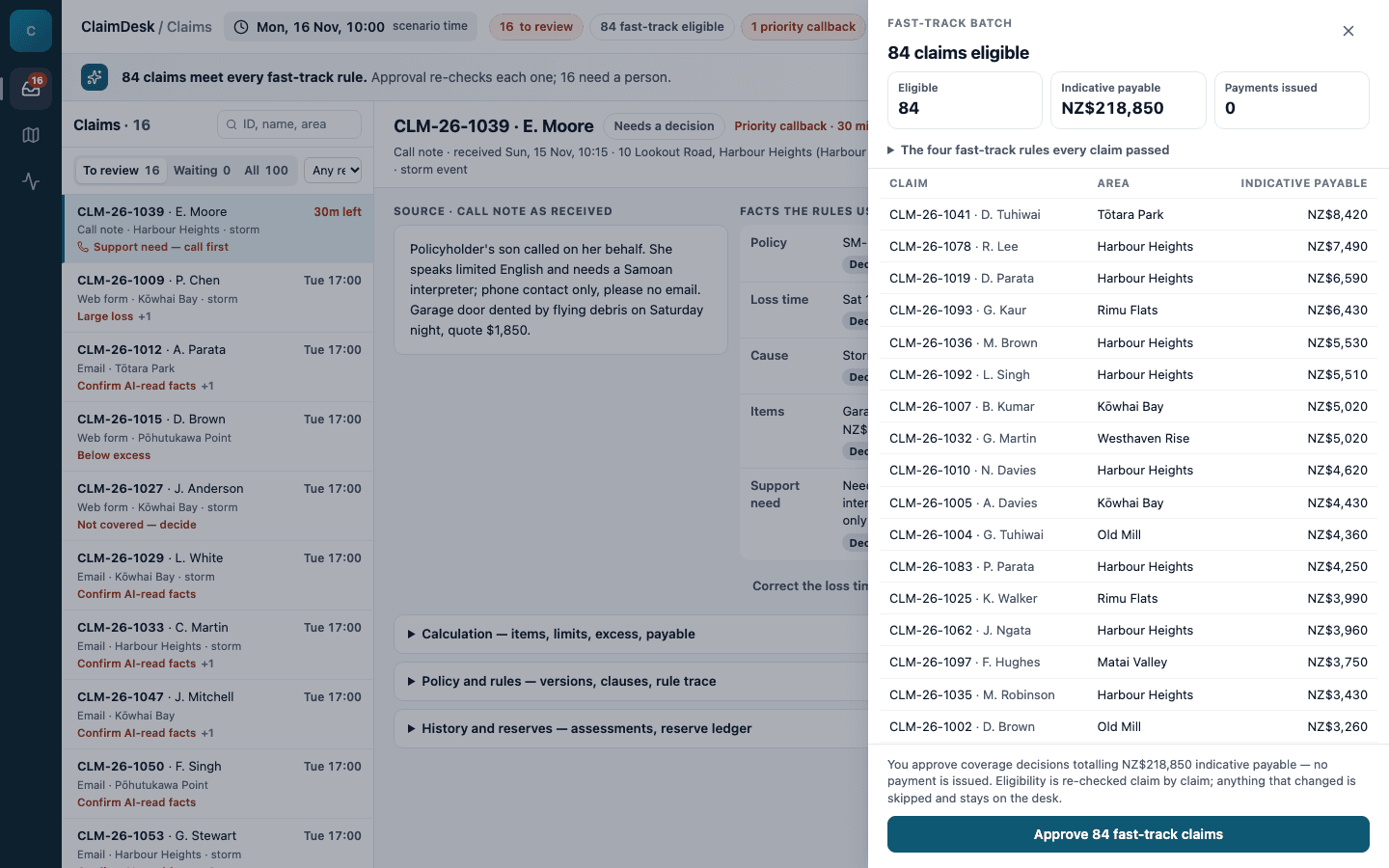
Fast-track batch: 84 claims reviewed and approved in one action, with their indicative payable. Step 3
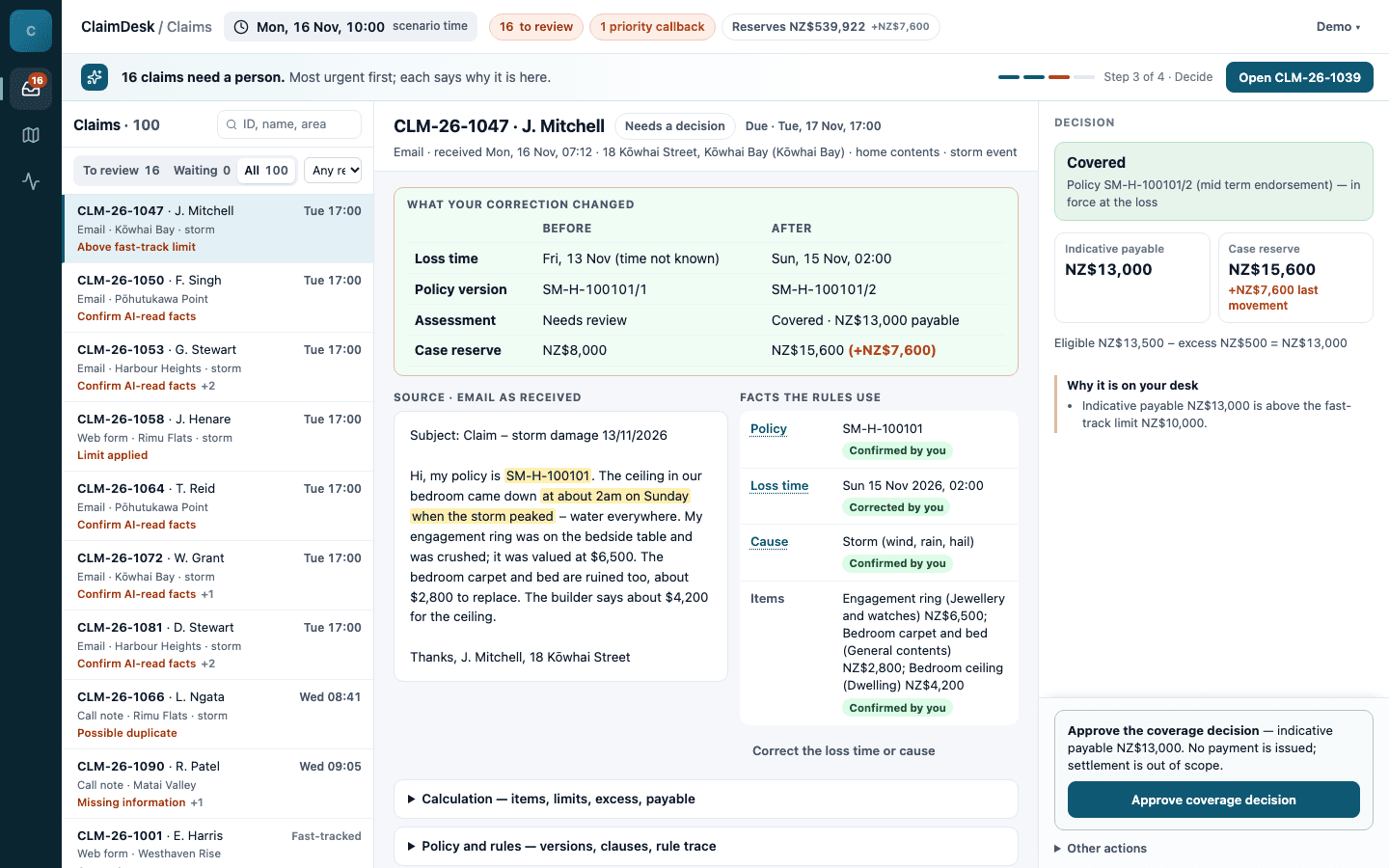
A corrected loss time changes the policy version, the outcome and the reserve, in one atomic reassessment.
Engineering invariants
Rules the system enforces whatever the user does, and where each one is proven.
| Invariant | Why it matters | Evidence |
|---|---|---|
| No automatic fast-track or adverse outcome while a critical fact is unconfirmed, the policy is unverified or an exclusion is ambiguous. Eligibility is recomputed under a row lock at approval. | Uncertainty goes to a person, never to an automatic decline. | Fast-track gate (opens in a new tab)Unit/Claims/ClaimsDomainTest.php :: testFastTrackNeedsVerifiedFactsAndReturnsEveryReason |
| The policy version and wording must be the same across the whole possible loss time; otherwise the claim goes to review. | A date-only loss on an endorsement day cannot silently pick the wrong policy. | Temporal policy resolution (opens in a new tab)Unit/Claims/ClaimsDomainTest.php :: testPolicyVersionIsResolvedForTheWholePossibleLossTime |
| A reassessment (facts, new assessment, reserve adjustment, journal) commits together or not at all. A stale version gets 409 and changes nothing. | Concurrent edits cannot lose changes or let the reserve and assessment drift apart. | Optimistic concurrency (opens in a new tab)Functional/ClaimDeskApiTest.php :: testConcurrentDecisionsOnAStaleVersionAreRejected |
System architecture
Key decisions
Keep the indicative payable (what the wording would pay) apart from the case reserve, with an append-only adjustment ledger.
Why: What a policy would pay is not the insurer's exposure; reserve movements must be audited and reconcile.
Rejected: Deriving the reserve from the payable alone.
docs/specifications/011-claimdesk.md 'Reserve contract' and Non-goals
Success is 'Needs a decision now: 0', with waiting work still visible and every claim given an owner and a due time.
Why: An empty queue is not success; waiting claims still need owners.
Rejected: An empty queue as the success state.
docs/specifications/011-claimdesk.md §9 Owner brief vs review
Engineering evidence
End-to-end
Playwright storm morning + check groups with axe
The storm morning end to end plus six groups of checks, with axe. 9/9 passing on production on 26 Nov 2026.
Conditions: Desktop and mobile smoke
Decision records
ADR
Shared ADR 0003 (fixture-first AI) and ADR 0004 (registered rules); six versioned rules form each claim's decision trace.
Engineering page
“How it's engineered” in the live demo (opens in a new tab)
The full detail: rules, data model, tests and measurements, next to the running product.
I use AI-assisted development for implementation, exploration and review. I remain responsible for architecture, business rules, code quality and deployment. Critical behaviour is verified with deterministic tests, static analysis and reproducible benchmarks.
Trade-offs and limits
- Synthetic data; the insurer, policies and wordings are fictional
- No quoting, underwriting, payments or photo analysis
- Reserve policy is declared for the demo, not actuarial
- Nothing is sent to customers
My contribution
I built ClaimDesk as an independent engineering showcase: product specification, architecture, frontend, backend, data model, automated tests and deployment.
Want to discuss the engineering behind this?
Launch demo (opens in a new tab)Get in touch
Source-code walkthroughs available on request.