Pixel Brisbane
An interactive isometric map of Brisbane, combining buildings, places and useful city data.
Designed and built by me.
- WebLive
What it does
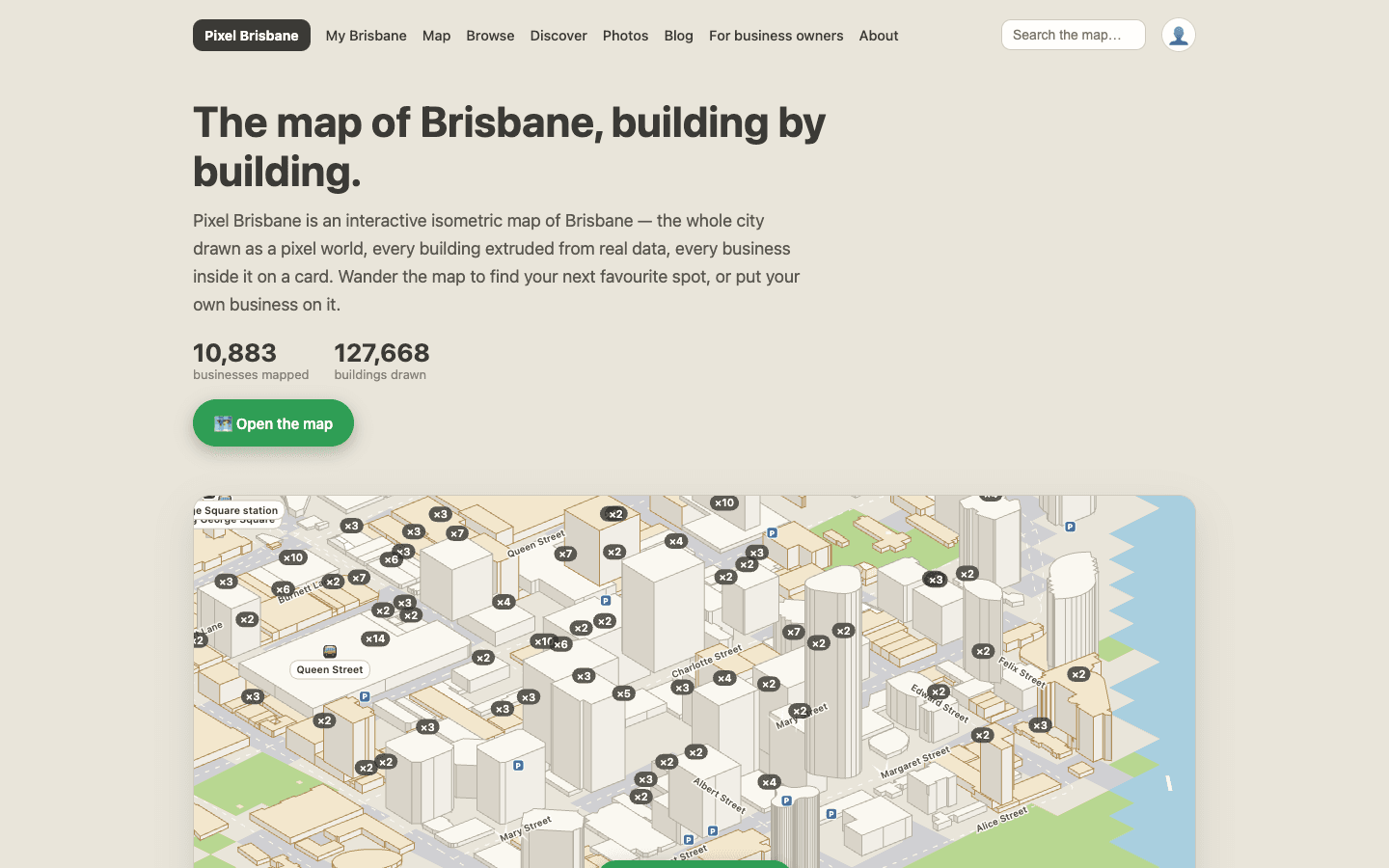
Pixel Brisbane draws the whole of Brisbane as an isometric pixel map. Every building is extruded from its real footprint, streets keep their lane markings, and each business sits inside the building it actually occupies.
- Explore the city: 127,668 buildings and 10,883 businesses across 187 suburbs.
- Switch on layers: train, busway and ferry lines with 174 stations and terminals, Council river flood zones checked against 22,753 buildings, 435 schools with their catchments, heritage-listed places, public parking, dog parks, playgrounds and EV chargers.
- See which businesses should be open now, based on their published opening hours.
- Browse photos that people have pinned to the exact spot on the map.
- Claim a business for free through a link emailed to its publicly listed email address, or with a badge on its website. There is no password to set and no form to fill in.
The numbers come from the live site in October 2026 and change as the data is synced.
Why an isometric map
I did not want the city to become another list of places. In a directory, a fourteen-storey tower and a corner shop look identical. On Pixel Brisbane the building itself is part of the interface: a badge shows how many businesses are inside, and one click opens the whole building. Because businesses stay attached to their real buildings, dense commercial streets are visible straight from the map.
Key decisions
Open data, with a source on every card. Instead of keeping a closed places database, the map combines public datasets. Each card says where its facts came from and when they were last synced.
A custom isometric renderer. The map does not use satellite imagery or a standard pin-based map. Buildings, transport lines, overlays and business markers are drawn in one visual system.
Verification without a manual review form. A business proves it is theirs through its published email address or a verification badge on its own website.
Human-reviewed corrections. Every listing has a “Spotted an error?” link. Submitted corrections are reviewed by a person rather than applied automatically.
How it is built
The datasets behind the map were never designed to work together. Businesses from OpenStreetMap are placed inside building footprints, matched to the Australian Business Register for the “Registered business” badge, and given suburbs and postcodes from G-NAF. Council flood zones are matched against every footprint, and TransLink timetables feed the stations layer. The same engine that places a cafe in its building also draws the other layers, and each fact keeps the source it came from.
Data sources
| Source | Used for |
|---|---|
| OpenStreetMap | Building footprints, streets, parks, the river and the businesses themselves (ODbL) |
| Australian Business Register | ABNs matched to listings, behind the “Registered business” badge |
| G-NAF | Suburbs and postcodes |
| Wikidata | Official websites for national chains |
| ABS Census 2021 | Suburb profiles: population, median age and rents |
| Brisbane City Council flood awareness | River flood zones matched to every building footprint |
| Queensland Heritage Register | State-listed heritage places |
| TransLink GTFS | Train, busway and ferry timetables (CC BY 4.0) |
| Education Queensland | School locations and state-school catchments |
Current state
Live at pixelbrisbane.com. The newest feature is a photo gallery: people upload photos from their phones, and each one is placed on the map using the location stored in the photo.
Details
- Platforms
- Web — live
- Role
- Designed and built by me.
- Category
- Maps & data
- Website
- pixelbrisbane.com
More projects
All projectsDrums3D
A 3D drum kit for the browser and Meta Quest, for playing, practising and exploring rhythm.
- WebLive
- Meta QuestBeta
Built with Astro · TypeScript
Knoverge
A shared, self-hosted knowledge base for people and AI agents, with review and version history.
- WebIn development
Built with TypeScript · React · Node.js